
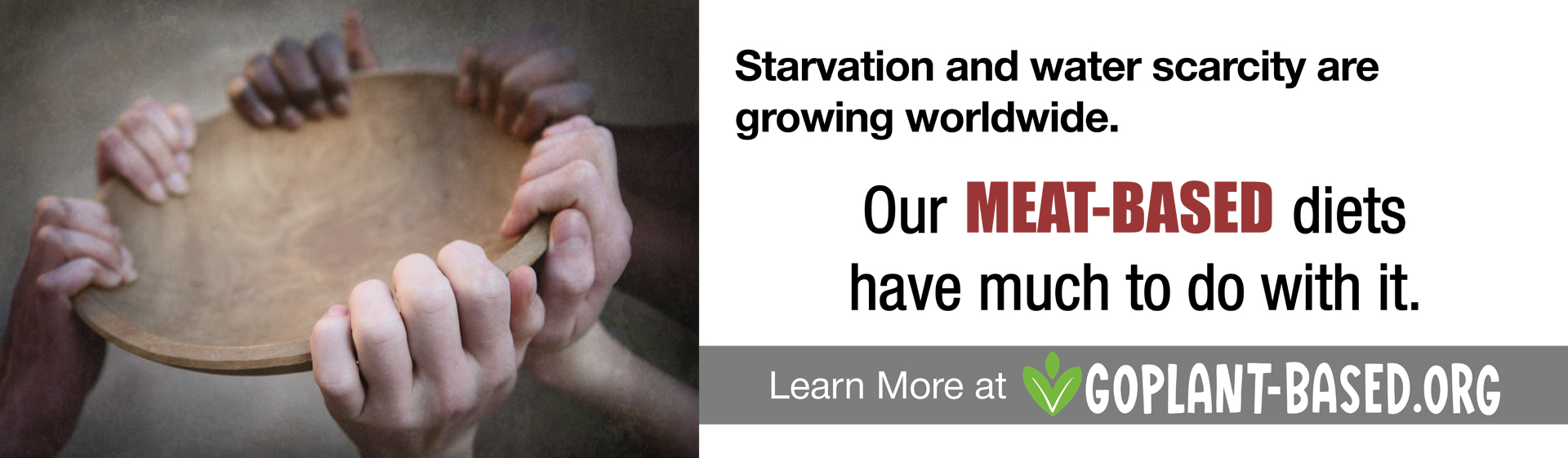
Starvation and water scarcity are growing worldwide.
Our meat-based diets have much to do with it.
Most people tend to think of world hunger and thirst as insurmountable issues that we can’t do anything about as individuals. The numbers are too large for our brains to even comprehend: Nearly 1 billion people are malnourished, and severe water scarcity affects billions more. With the global population projected to exceed 10 billion by 2100, the challenges around food and water resources become more urgent every year.
Solving these problems for good is, of course, incredibly complex. But if you want to start making a positive change in the world today, the science is clear about how to have the biggest impact — and no, it doesn’t require becoming ridiculously wealthy and donating millions to charity.
The simplest thing you can do also happens to be the most budget-friendly: eat less meat and more plants.
So, what exactly does eating a steak have to do with world hunger and thirst? Let’s dive in.
“The global demand for animal products drives malnourishment, starvation, water scarcity, resource depletion, and poverty.”
Land used for livestock exacerbates world hunger
Around 80% of global agricultural land is used for livestock production, despite those animals only producing 18% of the world’s calories. We produce enough grain to feed twice the global population, yet we lose half of it to animal feed and another third to food waste. Producing one pound of meat usually requires three pounds of grain, which is a highly inefficient practice.
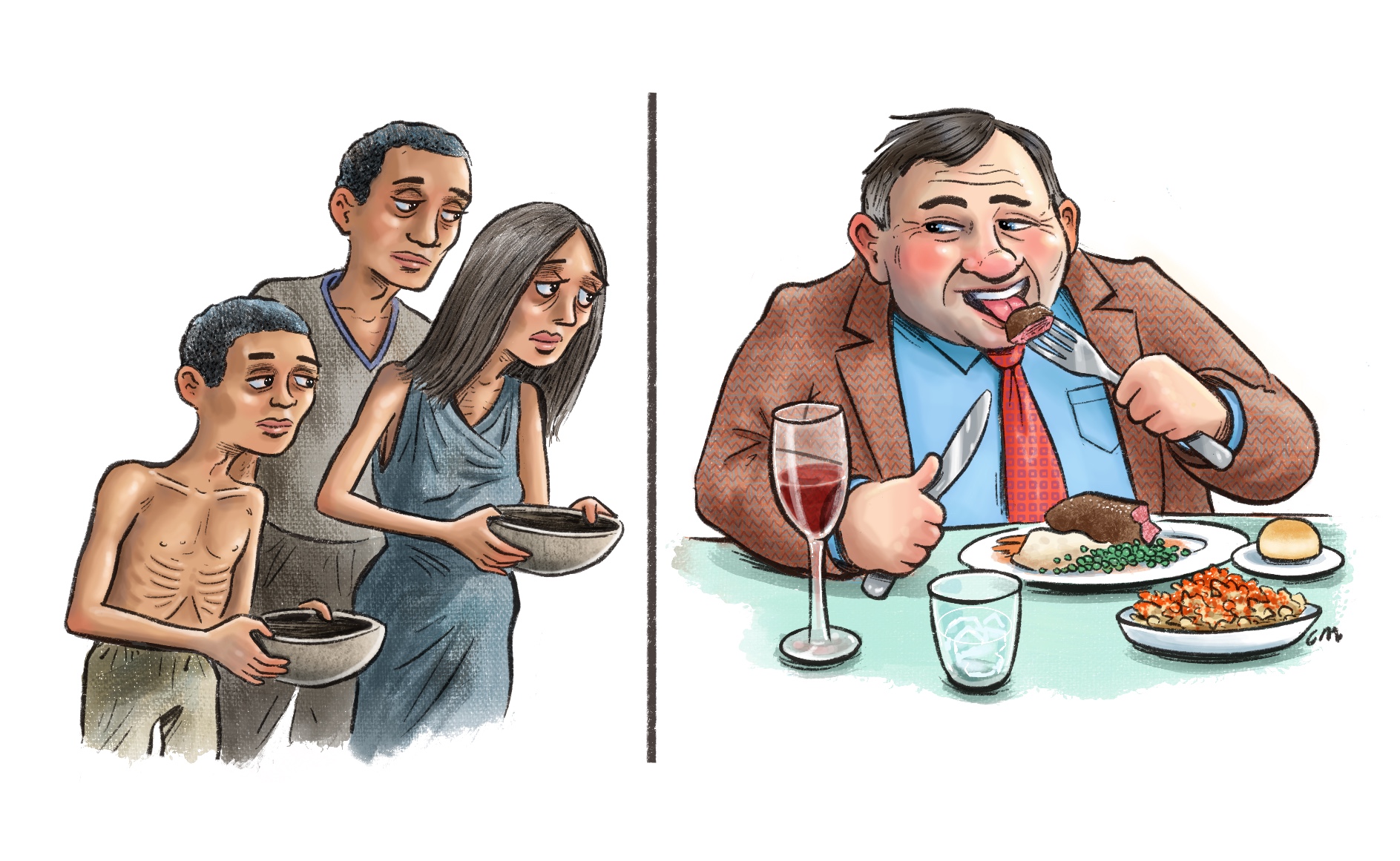 If we stopped giving up these crops to intensive livestock production and redirected them for human consumption instead, it would greatly increase our global food supply. In fact, it would provide us with enough food to feed 10 billion people by 2050 within environmental-friendly limits.
A related issue is that the more land is used for raising animals and growing their feed, the more expensive that land becomes. This makes it increasingly difficult for poorer populations to access crucial resources for their own agricultural activities or even for housing. If the global demand for meat keeps rising, the industry will continue to displace small-scale farmers and indigenous communities, depriving them of their livelihoods and leaving them vulnerable to poverty and hunger.
Animal agriculture wastes our water
More than 2.1 billion people currently don’t have access to safe drinking water. By 2025, around 1.8 billion people will live in regions with total water scarcity, and two-thirds of the global population will face water-stressed conditions.
Animal agriculture not only demands enormous amounts of water, but uses it inefficiently. Growing crops for livestock in developing countries requires a staggering 2 trillion cubic meters of water annually, while livestock production itself uses an additional 536 billion cubic meters. Agriculture consumes 70% of global freshwater, and feed crops alone are responsible for 20%.
To put this into perspective, it takes five times more water to supply 10 grams of protein from beef than from rice, and 20 times more water to provide 500 calories. This waste of water resources amplifies scarcity, especially in regions that are already struggling to access clean drinking water.
Livestock production is energy-intensive
The livestock supply chain demands massive amounts of energy. Eating beef uses 160 times more land, water, and fuel than eating a vegetarian dish.
How is that possible? Well, all of the machinery, fertilizers, and irrigation need lots of power to produce animal feed on such a large scale. Transporting the animals, animal products, and feed adds another layer of energy consumption that relies heavily on fossil fuels. The facilities that slaughter and process animals into meat products consume large amounts of electricity as well, mainly from non-renewable resources. And on top of that, the need for refrigeration throughout the entire supply chain — from the processing plants all the way to the grocery stores — drives up energy consumption even further.
Converting plant-based calories to animal products wastes precious energy resources, while significantly contributing to environmental pollution and climate change.
How does adopting a plant-based diet help with world hunger and thirst?
The global demand for animal products drives malnourishment, starvation, water scarcity, resource depletion, and poverty, especially in developing countries. 82% of starving children live in regions where much of the food that’s grown goes straight to feeding animals, which are then killed and eaten by wealthier people in developed countries like the United States.
Of course, tackling major issues like world hunger and thirst requires a multidimensional approach. But on an individual level, the latest research urges us to prioritize going plant-based.
A plant-based diet consumes substantially fewer resources. It’s more efficient than an animal-based diet in every way, from energy to protein to land and water use. This means that if we reduce the demand for meat by eating more plants instead, we’ll have a direct impact on global food security, alleviating water scarcity, distributing resources more fairly, and protecting the environment.
Not sure where to start? Consider adopting a “flexitarian” diet, where at least half of your calories come from fruits and vegetables, and animal protein is limited to a couple of meals per week. You’ll discover a whole world of new flavors and excellent sources of plant-based protein that are not only better for your health, but also play a crucial role in reducing world hunger and thirst.