
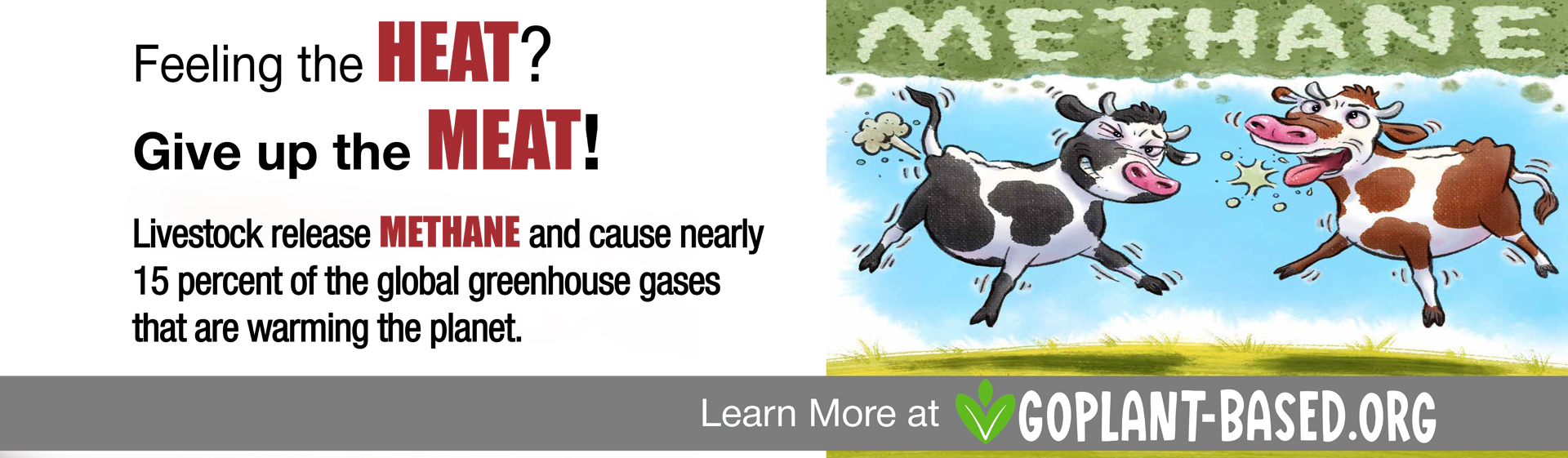
Feeling the heat? Give up the meat!
We’ve all heard about how greenhouse gas emissions are negatively impacting the climate. But there’s a huge culprit that’s often left out of the conversation: animal agriculture.
In the US, 99% of animals that are raised for food are kept in abusive factory farm environments. Not only is it cruel, but the industry is responsible for at least 14.5% of all global greenhouse gas emissions — more than cars and planes. Animal agriculture is also the driving force behind deforestation and biodiversity endangerment.
So, why isn’t this more widely talked about? The media consistently falls short in its coverage of these hard truths, leaving a gap in public awareness. Let’s get to the heart of the issue, and discover what actions we can take right now to help with climate change.
How does animal agriculture contribute to climate change?
Farmed animals such as cows, goats, and sheep release methane gas into the atmosphere every time they belch. Methane is a powerful greenhouse gas that traps heat from the sun. When enough of that heat can’t be released into space, it’s highly dangerous for the planet.
Although carbon dioxide emissions hang around in the atmosphere for longer, methane is 28 times more potent over a 100-year period. With cattle as one of the biggest sources of methane emissions globally, we can begin to see what a massive climate problem we have on our hands.
Unfortunately, methane isn’t the only greenhouse gas linked to animal agriculture. Dangerous levels of nitrous oxide are being emitted because of the way factory farms process and store enormous amounts of manure. This greenhouse gas is 273 times more powerful than carbon dioxide over a 100-year time span.
“Animal agriculture is the driving force behind deforestation and biodiversity endangerment.”
And the problems don’t even stop there. The relentless expansion of animal agriculture is driving deforestation at an alarming rate, destroying vital ecosystems and further exacerbating climate change. In the Amazon rainforest, for example, cattle ranching is responsible for 80% of deforestation. They use the land to produce soy, a main ingredient in animal feed, and to make more room for animals that will be slaughtered for their meat. The unsustainable way in which we produce food is the main reason we’re losing biodiversity and accelerating the destruction of our planet.
The entire livestock supply chain — from feed production to animal digestion to manure management — is directly responsible for about 15% of human-caused greenhouse gas emissions. And when you consider that the production of meat, eggs, and dairy accounts for up to 83% of global farmland use, the immense environmental footprint of animal agriculture is undeniable.
As the world population continues to increase, it will be impossible to prevent climate disasters if we don’t reduce our reliance on factory farming.
Can a plant-based diet really make a difference?
If we were to completely eliminate fossil fuel usage today, the impact of the food sector is drastic enough that we still would not be able to stop the impending climate crisis. So while animal agriculture is not the only contributor to climate change, the reality is that we cannot solve this problem without overhauling our diets and producing food more sustainably.
Scientific research shows that our most hopeful path forward involves embracing plant-based diets. A 2022 model found that phasing out animal agriculture over the next 15 years would benefit the planet in a much faster and larger way than you might think.
Even if all other sources of greenhouse gases were to continue at their current emission levels, the phase-out of animal agriculture would be enough to pause net emissions for the next 30 years, and offset nearly 70% of the heating effect through the end of this century. This transition would also help us halt deforestation and preserve biodiversity by recovering 80% of humanity’s land footprint currently devoted to livestock.
In addition, widespread plant-based eating would give us a more sustainable solution to food insecurity and resource scarcity. Plant-based diets require significantly less land, water, and energy compared to diets that include animal products. This means that our dietary choices today will not only help mitigate climate change but also ensure that we have food security for future generations.
The authors of the study acknowledge the likelihood that “a substantial global investment will be required to ensure that people who currently make a living from animal agriculture do not suffer when it is reduced or replaced.” But this investment, they say, “must be compared to the economic and humanitarian disruptions of significant global warming.”
Objectively, there’s no good reason why over 70 billion land animals need to be raised and killed every year for food, using processes that cause such colossal damage to our environment. Besides the impact on climate change, individual health, and food security, policies that encourage plant-based eating benefit the economy as well. A recent report demonstrated that transitioning to a net-zero emission economy in Latin America and the Caribbean — driven mainly by consuming less meat — would result in the net creation of 15 million more jobs.
What actions can I take to help with climate change?
Climate scientists have been sounding the alarm for years, and there’s no denying that we need long-term solutions put in place by governments and institutions. If we’re going to see a real reduction in greenhouse gas emissions, we need to redirect public investment and financial incentives from industrialized animal agriculture to sustainable plant-based alternatives.
But on an individual level, the most powerful climate action you can take is simple: eat less meat and more plants.
It may not sound like much, but it really does make a difference: One study showed that swapping beef for plants would reduce the greenhouse gas emissions of the average American diet by a whopping 96%. And it doesn’t have to be all or nothing — even if you just make a few substitutes to consume 70% fewer animal products on average, we could get much closer to our emissions goal.
Try experimenting with delicious recipes that incorporate more vegetables, fruits, legumes, and whole grains. You’ll discover a whole world of new flavors and excellent sources of plant-based protein that are not only kinder to the planet, but also nourishing for your body.
We’ve arrived at a critical point in human history where it’s really up to all of us to turn the tide of the climate crisis. By transitioning to a plant-based diet while advocating for systemic change, we hold so much potential to make a difference. With every bite we eat, we can actively choose compassion over exploitation, and sustainability over destruction. The time for action is right now.